How would the implementation of open electricity market affects the price of electricity? One can now sign-up for alternative electricity providers in Singapore to save up to 21% on bills.
Advance estimates show that Singapore's gross domestic product
(GDP) grew by just 0.3% in April-June on a quarter-on-quarter, seasonally
adjusted and annualised rate (SAAR), slowing sharply from the first quarter's
10% pace. However, compared to a year ago, the economy is likely to expand by 2.4%, faster than the 1.6% pace recorded in the first three months of 2012. This could be attributed to the expanding manufacturing sector, which
takes up a quarter of Singapore’s GDP. The relatively better performance in the
rig-building and pharmaceutical industries helped to negate the weaker
performance in the electronics industry.
In addition, the Singapore economy has also benefited from a strong
growth in tourism and construction sectors. The financial sector, which takes up 12% of Singapore's GDP, on the other hand, is weakening due to weakness in the equity markets.
Source: Singapore GDP likely
slowed in Q2, possible contraction 9 July 2012
Crude oil prices rise on news of a halt of production by the world's seventh largest oil producer Norway's energy industry ordered a lockout next week that
threatens to bring production to a halt in Western Europe's largest oil
exporter and the world's number two gas supplier. The lockout was announced
after a massive strike by more than 700 North Sea oil workers over pensions.
The lockout will mean that 6,515 workers covered by offshore pay agreements
will not be permitted to enter their workplaces.
· At a time when global supplies are already being hit by an embargo
on Iranian oil, halting the production of the world’s seventh largest oil
exporter has caused the crude oil prices to rise.OLF, the employers’
organization, is speculating that Norway will be seen as an unreliable gas
supplier. The threat of a lockout was also prompting speculation that the
Norwegian government would step in, noting that the country's US$600 billion
sovereign wealth fund was entirely dependent on oil revenue
Pay rises eroded by high inflation,
real wage growth 0.9%
·Even though the tight labour market raised wages by 6.1%, Singaporeans
only enjoyed a real wage growth of just 0.9%. This was much lower than the real wage growth of 2.9 per
cent workers enjoyed in 2010.Most of the wage increase was eroded by inflation.
·The twin scenarios of high wages and high inflation point towards a
wage-price spiral but economists remain divided on this occurrence. This is
because the uncertain economic conditions may cool global demand and hence,
place lower pressures on wage increase.
·Policy measures to raise real wages have been deliberated. Options such
as raising absolute wages and boosting the pay of the low-wage earners have
been contemplated upon.
http://www.euronews.com/
The total number of people out of work in the eurozone hit almost 18.5 million in September as the latest figures show unemployment at record levels in September 2012.
What is unemployment?
What do you think is the main cause of unemployment in Eurozone?
Why is inflation?
Why has inflation ease?
Is tax cut necessary?
How does it helped the economy?
What is inflation?
What causes inflation?
What is the difference between cause-push and demand-pull inflation?
What are the effects of inflation?
How is inflation measured?
How does the central bank monitor inflation?
Secondary simulation games Fun and interactive, simulations games use role-play and decision-making to explore real life global issues. The Chocolate Trade Game - Simulation game about fair trade The Paper Bag Game - Simulation game about poverty The Poverty Challenge - Simulation game about poverty and sustainable development The Trading Game - Simulation game about trade and economic development Trading trainers - Simulation game about labour and fair wages
Role play on the topic "Trade or Protect?" The ASEAN Free Trade Agreement (AFTA) called for Malaysia to reduce tariffs in its car industry drastically.
Role 1: CEO of Proton As CEO of Proton, you decide to lobby the government to press for a 2 year extension before the tariff reduction takes effect. Present arguments for your stance.
You may want to consider the effect of your stance on domestic firms, workers, economic growth etc.
v Imports of foreign cars, increased competition. v Dumping of foreign cars v Malaysian car firms cannot compete with the cheaper ASEAN car imports v Malaysian workers maybe retrenched, wages may decrease due to increased competition v Prevent reliance on foreign products v Prevent great outflow of foreign exchange v Continued monopoly of market, maintain supernormal profits.
Role 2: Secretary-general of ASEAN As the secretary-general of ASEAN, present arguments why this AFTA deal will be beneficial to Malaysia.
You may want to consider the effect of the deal on Malaysian firms, workers, economic growth.
v Lower trade barriers => Malaysians gets access to greater car choices, higher utility, lower prices v Domestic car workers may be laid off, but will move to productive sectors where Malaysia has comparative advantage v Tariffs => direct more workers into car industry where their productivity is less, and direct workers out of other sectors where their productivity is greater; thus, restrictive trade policy would lower the overall productivity, and wages, of workers in Malaysia v Ensure much needed reforms in the car industry in Malaysia v Cheaper transportation costs by Malaysian firms =.> more competitive exports
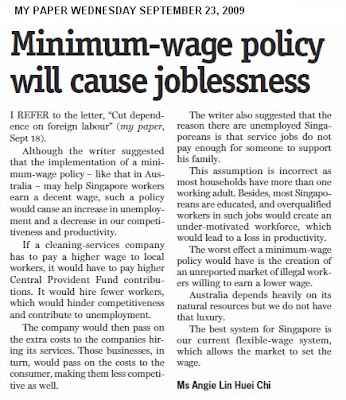
Read the news article below and think about the following questions: 1. What is a minimum-wage policy? 2. How does minimum-wage policy affect employment? 3. How does the article shows that the aims of government might conflict with each other?
This article appeared on the Straits Times on the 31st March.
Economists say the combined pressures of a deepening recession and collapsing exports mean the MAS will probably allow the currency to fall further in value against other currencies. A weaker Singdollar would make exports more attractive, but would also mean that imports and trips overseas for Singaporeans may become more expensive.
The MAS conducts monetary policy through exchange rate adjustments, which it carries out by trading the Singdollar within an undisclosed band.
Points to ponder on: 1. What is the term used to describe the fall of the currency in value against other currencies? 2. How will the weaker Singdollar affect our terms of trade and balance of payment? 3. How is exchange rate adjustments made by the MAS?
The leaders of the world’s largest economies came together in London to deal with the global financial crisis. Read more about it on http://www.londonsummit.gov.uk/en/.
The focus of the G20 summit was on Stability, Growth and Jobs. The members are: Argentina, Australia, Brazil, Canada, China, France, Germany, India, Indonesia, Italy, Japan, Mexico, Russia, Saudi Arabia, South Africa, South Korea, Turkey, the UK, the US and the EU. Gordon Brown's closing speech at the G20 summit - headlines by BBC live broadcast on 2 April 2009 :
Global problems require global solutions
Agreed $1 trillion extra for IMF and other - increased liquidity
Protectionist countries will be named and shamed - commitment to fight all forms of protectionism and maintain open trade
Exchange of tax information - End to tax havens that aren't open to international scrutinity
Banking secrecy of the past must end
Sorting out problems of the banking system. Establish more confidence with the banks - people secured with homes and jobs. Regulatory system to deal with restructuring of banks.
New rules on pay and bonuses globally
Injection of $5 trillion to boost world economy - largest fiscal stimulus
A new world order is emerging
French President Sarkozy: Conclusions are more than we could have hoped for..there will be more scrutiny and strighter regulation on funds.
The big picture - how the topics are related for O level Econs. I hope that this mindmap will help you see the relationship. Click on the image for a bigger view.
Define exchange rate. The rate at which one currency can be exchanged for another
Explain what is meant by the appreciation of exchange rate. A rise in the value of the country’s currency (e.g. £) in relation to other currencies – each £ buys more of the other currency.
Explain what is meant by the depreciation of exchange rate. A fall in the value of the country’s currency (e.g. £) in relation to other currencies – each £ buys less of the other currency.
The value of exports might be affected by changes in a country’s exchange rate. Discuss why exchange rates fluctuate. Exchange rates fluctuations reflect changes In the demand for and supply of the currency in the foreign exchange market which can be attributed to: § Credit items / capital inflows ( Demand for the country’s currency ) § Debit items / capital outflows ( Supply of the country’s currency ) Comment on factors affecting current account flows / capital flows Exchange rates are determined by the interaction of demand for, and supply of, the currency in the foreign exchange market. The factors causing changes in floating exchange rates are many and varied. Exchange rates are determined by the demand for and the supply of currencies on the foreign exchange market. What are the factors which influence the demand and supply for currencies? Relative interest rates, the demand for imports (D£), the demand for exports (S£), investment opportunities, speculative sentiments, global trading patterns, changes in relative inflation rates
Explain how appreciation and depreciation of exchange rate can affect the balance of payment. A depreciation in exchange rate should lead to a rise in demand for exports, a fall in demand for imports – the balance of payments should ‘improve’ An appreciation of the exchange rate should lead to a fall in demand for exports and a rise in demand for imports – the balance of payments should get ‘worse’ But The volumes and the actual amount of income and expenditure will depend on the relative price elasticity of demand for imports and exports.
10 April 2008 0819 hrs Channel News Asia SINGAPORE: The Monetary Authority of Singapore (MAS) further tightened monetary policy on Thursday in a bid to address a sharp rise in inflation, allowing the Singapore dollar to continue to rise against other currencies. The move sent the Singapore dollar to all-time highs at US$1.3623 in morning trade, against 1.3810 late Wednesday. In its semi-annual policy statement, the MAS said consumer prices have risen sharply since the second half of last year, reflecting both external and domestic factors. From 0.8 per cent in the first half of last year, consumer price index (CPI) inflation accelerated to 6.6 per cent in January-February, the MAS said. The MAS conducts monetary policy through the local currency rather than by setting interest rates.
The Singapore dollar is traded against a basket of currencies of the city-state's major trading partners within an undisclosed trading band known as the nominal effective exchange rate (NEER). Since its last policy review in October, the NEER has fluctuated in the upper half of the band, the MAS said. "Against this backdrop of continuing external and domestic cost pressures, an upward shift of the policy band at this point will help to moderate inflation going forward, while providing support for sustainable growth in the economy," it said. "MAS will therefore re-centre the exchange rate policy band at the prevailing level of the NEER." Details of the trading band are not made public to prevent speculation in the Singapore dollar. The government on Thursday said Singapore's economy grew at a faster 7.2 per cent in the first quarter of the year, in a report that beat the average forecast made by economists. On April 11 last year, the Singapore dollar was trading at US$1.5182. - AFP/ac
Read the article and relate it to what you have learnt, especially those in bold. Explore the role of the government in sustaining economic growth as well as how the exchange rate can affect consumer prices and helps to moderate inflation.