0

MAS may weaken S$

Posted by Economics Corner on 8:54 AM
This article appeared on the Straits Times on the 31st March.

Economists say the combined pressures of a deepening recession and collapsing exports mean the MAS will probably allow the currency to fall further in value against other currencies. A weaker Singdollar would make exports more attractive, but would also mean that imports and trips overseas for Singaporeans may become more expensive.

The MAS conducts monetary policy through exchange rate adjustments, which it carries out by trading the Singdollar within an undisclosed band.

Points to ponder on:
1. What is the term used to describe the fall of the currency in value against other currencies?
2. How will the weaker Singdollar affect our terms of trade and balance of payment?
3. How is exchange rate adjustments made by the MAS?


0

G20 summit

Posted by Economics Corner on 8:23 AM
The leaders of the world’s largest economies came together in London to deal with the global financial crisis. Read more about it on http://www.londonsummit.gov.uk/en/.

The focus of the G20 summit was on Stability, Growth and Jobs.
The members are: Argentina, Australia, Brazil, Canada, China, France, Germany, India, Indonesia, Italy, Japan, Mexico, Russia, Saudi Arabia, South Africa, South Korea, Turkey, the UK, the US and the EU.

Gordon Brown's closing speech at the G20 summit - headlines by BBC live broadcast on 2 April 2009 :

  • Global problems require global solutions
  • Agreed $1 trillion extra for IMF and other - increased liquidity
  • Protectionist countries will be named and shamed - commitment to fight all forms of protectionism and maintain open trade
  • Exchange of tax information - End to tax havens that aren't open to international scrutinity
  • Banking secrecy of the past must end
  • Sorting out problems of the banking system. Establish more confidence with the banks - people secured with homes and jobs. Regulatory system to deal with restructuring of banks.
  • New rules on pay and bonuses globally
  • Injection of $5 trillion to boost world economy - largest fiscal stimulus
  • A new world order is emerging

French President Sarkozy: Conclusions are more than we could have hoped for..there will be more scrutiny and strighter regulation on funds.


1

Mindmap

Posted by Economics Corner on 8:49 AM
The big picture - how the topics are related for O level Econs. I hope that this mindmap will help you see the relationship. Click on the image for a bigger view.

0

exchange rate

Posted by Economics Corner on 3:34 AM
Define exchange rate.
The rate at which one currency can be exchanged for another

Explain what is meant by the appreciation of exchange rate.
A rise in the value of the country’s currency (e.g. £) in relation to other currencies – each £ buys more of the other currency.


Explain what is meant by the depreciation of exchange rate.
A fall in the value of the country’s currency (e.g. £) in relation to other currencies – each £ buys less of the other currency.

The value of exports might be affected by changes in a country’s exchange rate. Discuss why exchange rates fluctuate.
Exchange rates fluctuations reflect changes In the demand for and supply of the currency in the foreign exchange market which can be attributed to:
§ Credit items / capital inflows ( Demand for the country’s currency )
§ Debit items / capital outflows ( Supply of the country’s currency )


Comment on factors affecting current account flows / capital flows
Exchange rates are determined by the interaction of demand for, and supply of, the currency in the foreign exchange market. The factors causing changes in floating exchange rates are many and varied.

Exchange rates are determined by the demand for and the supply of currencies on the foreign exchange market. What are the factors which influence the demand and supply for currencies?
Relative interest rates, the demand for imports (D£), the demand for exports (S£), investment opportunities, speculative sentiments, global trading patterns, changes in relative inflation rates


Explain how appreciation and depreciation of exchange rate can affect the balance of payment.
A depreciation in exchange rate should lead to a rise in demand for exports, a fall in demand for imports – the balance of payments should ‘improve’
An appreciation of the exchange rate should lead to a fall in demand for exports and a rise in demand for imports – the balance of payments should get ‘worse’ But
The volumes and the actual amount of income and expenditure will depend on the relative price elasticity of demand for imports and exports.


0

MAS continues to tighten Singapore's monetary policy

Posted by Economics Corner on 5:59 AM
10 April 2008 0819 hrs Channel News Asia

SINGAPORE: The Monetary Authority of Singapore (MAS) further tightened monetary policy on Thursday in a bid to address a sharp rise in inflation, allowing the Singapore dollar to continue to rise against other currencies. The move sent the Singapore dollar to all-time highs at US$1.3623 in morning trade, against 1.3810 late Wednesday. In its semi-annual policy statement, the MAS said consumer prices have risen sharply since the second half of last year, reflecting both external and domestic factors. From 0.8 per cent in the first half of last year, consumer price index (CPI) inflation accelerated to 6.6 per cent in January-February, the MAS said. The MAS conducts monetary policy through the local currency rather than by setting interest rates.


The Singapore dollar is traded against a basket of currencies of the city-state's major trading partners within an undisclosed trading band known as the nominal effective exchange rate (NEER). Since its last policy review in October, the NEER has fluctuated in the upper half of the band, the MAS said. "Against this backdrop of continuing external and domestic cost pressures, an upward shift of the policy band at this point will help to moderate inflation going forward, while providing support for sustainable growth in the economy," it said. "MAS will therefore re-centre the exchange rate policy band at the prevailing level of the NEER." Details of the trading band are not made public to prevent speculation in the Singapore dollar. The government on Thursday said Singapore's economy grew at a faster 7.2 per cent in the first quarter of the year, in a report that beat the average forecast made by economists. On April 11 last year, the Singapore dollar was trading at US$1.5182. - AFP/ac

Read the article and relate it to what you have learnt, especially those in bold. Explore the role of the government in sustaining economic growth as well as how the exchange rate can affect consumer prices and helps to moderate inflation.

1
Posted by Economics Corner on 6:57 PM
An interesting news article which you might want to look at:

MPs raise concerns about Singapore's monetary policy
By Wong Siew Ying, Channel NewsAsia Posted: 27 February 2008 2142 hrs

When asked whether the Singapore dollar should be allowed to appreciate at a faster pace to tackle inflation in Parliament on Wednesday, Minister for Trade and Industry Lim Hng Kiang noted that Singapore cannot totally insulate itself from the effects of global prices. He said the Monetary Authority of Singapore (MAS) did allow the currency to appreciate at a faster rate during its last policy review in October 2007 amid uncertainties in external economic and financial markets. Although such move helped to counter inflationary pressure, Mr Lim, who is also the deputy chairman of MAS, reminded the House that there was a limit to how much the Singapore dollar can appreciate without hurting growth.

The other question raised was whether interest rates can be used as another tool to manage Singapore's monetary policy. Mr Lim said, "Studies by MAS over the years have shown consistently the exchange rate has the most significant impact on growth and inflation than interest rate. Once we have an open capital account, the monetary policy can only influence either the interest rate or the exchange rate but not both." "If you try to have an exchange rate at a certain level, then you still want to raise (the) interest rate… what will happen is you will attract a lot of inflow of foreign capital and your exchange rate (will) strengthen far beyond… (the) intended level," he added.

1. Define what is exchange rate.
2. Explain the meaning of appreciation of the Singapore dollar.
3. How can the exchange rate affect economic growth and inflation?
4. According to Mr Lim, why is it that the "monetary policy can only influence the interest or the exchange rate but not both"?
5. What is a capital account?

0

O level 2006 sample Economics paper and marking scheme

Posted by Economics Corner on 6:36 PM
You can download the 2006 paper and marking scheme from
http://www.cie.org.uk/qualifications/academic/middlesec/olevel/subject?assdef_id=906

Just a glimpse of the paper Q1:

Trade and production in Bangladesh

At one time, international trade agreements ensured an export market for clothes made in Bangladesh, but these were due to end in 2005. It was feared that many workers in Bangladesh would lose their jobs as a result. The Foreign Minister hoped that the trade in medicines would grow sufficiently to reduce that unemployment. The Foreign Minister said that in 2004 Bangladesh was exporting medicines to 60 countries and could produce them up to 70% cheaper than the Developed World. He said that if Bangladesh, a developing country, could get 2% of the global trade in medicines it could be worth many times the clothing exports that Bangladesh had lost.

In 2004, 150 local firms and 6 multi-national companies manufactured medicines in Bangladesh. However, the production of medicines employed just 50 000 workers and most future jobs would require highly trained technicians. The clothing trade employed 1.8 million unskilled workers and accounted for more than 75% of Bangladesh’s exports.

(a) State four ways in which multi-national companies can help developing countries such as Bangladesh. [4]

(b) International trade agreements can protect jobs. Despite this, some economists prefer free trade to trade agreements. Explain why. [6]

(c) Summarise the main argument of the Foreign Minister of Bangladesh. [4]

(d) Why might it be difficult for employment in the clothing industry to be replaced by employment in the manufacture of medicines? [6]

1 (a) employment, multiplier effects (do not expect this term), boost to exports, by encouraging development of new skills, introducing new technologies, improved working conditions, any other valid points, e.g. improvement in infrastructure.
1 mark each, maximum (4). [4]
There is no mark for a definition of a multi-national company.

(b) Analysis of the idea of specialisation and opening markets worldwide, production at lower costs, increased efficiency, more competition, wider choice, lower prices. Note: core candidates are required to know about specialisation at international level but not about comparative advantage.
Identification up to 3 marks. Explanation up to 3 marks. [6]
If candidates only deal with the first sentence, maximum of 4 marks.

(c) There will be unemployment if clothing manufacture ceases (1), but this could be replaced by manufacture of pharmaceuticals (1), boost exports (1), the great advantage that B has, was that its production was much cheaper than other countries (1). Straight copying: 2 marks maximum. [4]

(d) One industry is very labour intensive, the other is not. 50,000 currently in medicines, 1.8m currently in clothing.
Occupational immobility of labour. e.g. lack of skills.
Multi-national companies may be wary of locating in Bangladesh, due to possible instability.
(Note – we do not expect candidates to demonstrate a detailed knowledge of Bangladesh.) [6]

0

Interviews with students with distinction for Econs

Posted by Economics Corner on 3:08 PM
I must say I am proud of our first batch of students who took Economics at O level. All the 14 students passed (100%) with 8 of them scoring distinction(57.1%).

Read on for some of the interviews with students who scored distinction for Economics (2007).

How has the learning of Economics benefited you?
Studying Economics have helped me in my life. By studying the concept of Economics such as DEMAND AND SUPPLY, I am able to know how the market works. These concepts are pretty useful to be used in life. It certainly will help people in their everyday lives. It definitely helps me to think about how things go about (example: inflation and what causes it et cetera).

What do you think has led to you getting good results for the subject?
I think this is just an average result for my standard (laughs). To get good grade for this subject, I practice the concepts on a regular basis. I tried not to memorise these concepts. I only memorise the definitions. To be frank, I took a risk when I first chose this subject during Secondary 2. Firstly, I will be in the pioneer batch and thus, I won't have anyone to refer to (those who have taken this subject for O level). To further-aggravate the matter, we did not have a proper text book like what we usually have for other subjects. We only have some pretty good A level book and GCSE book from the UK. Fret not, I took everything in my stride. Fortunately for me, I have two rather dedicated teachers: Mrs. Patty Gan (Sec 3) and Mrs. Lily Lee (Sec 4). They were very passionate about helping the students to achieve good grades. Their passion triggers some baptism of fire in me to get good grades. Plaudits have to be given to them.To further spur me up, I got a bad result for my preliminaries: C5. I told myself to prove on the Real Stage. I pushed myself to at least achieve B3. By having the all-important slice of luck, I managed to achieve a distinction. At the end of the day, HARDWORK PREVAILS!

Would you encourage more students to take up the subject?
Without any doubt, I will encourage more students to take up the subject. Albeit the word Economics will send chills down student¡¯s spine (like what I felt at first), it is a rather-friendly subject. It is quite easy if you pay full attention in class. Economics is not a subject that is limited only in the classroom. One can easily use the concepts in their everyday lives. Like what, I have always done, I relate what I read in the news to Economics (almost everything: politics, social and even sports, entertainment). On hindsight, Economics is a subject that will benefit everyone. Definitely, a five-star subject. No doubts about that!

Zulkhairi Yaacob (Hougang Secondary 2007 Economics student)


After learning Econs I began to see things in different ways and perspectives. I could also apply some concepts to our daily life. It often helps to get a clearer and more realistic view of our future, for example like employment, and the wage rate- well at least for me. I used it to set my target for the course I am gonna apply for.

Actually, Econs is'nt hard at all. The foundation and basic is very important. Once you have grasped the concept correctly, you will be able to excel in it even without memorizing. So overall, Econs is great!!!

I opted for banking and finance as it's intake is'nt that many as compared to other business courses so I hope I get in. I think Econs will help me skip some of the modules which they are gonna teach.

Chun Rong 2007 Econs student

Learning econs has benefitted me a lot. After taking up the subject, I look at many things from a different perspective. When I read an article about, let's say for example "rising costs of flour" in the papers, I understand the causes and effects of the phenomenon. Before I learnt Economics, I would skip such articles because I know I would'nt understand it even I if read on.

Basically, Econs has enabled me to have a deeper understanding of the things happening around me. I would definitely encourage more students to take up economics, because the knowledge it gives is very practical and applicable to one's everyday life.

Economics is involved whenever there is buying and selling going on. Economics is not just an O level subject, it is a life skill - something that one would use throughout his life.

As for me, I loved the subject. The interest made me try to relate the everyday things in my life with the subject; like for example, when I notice that there's a rise in price of the food in a hawker center,I think about the possible factors that might have caused it. It eventually became a habit sort of thing, and as I used to say only as a joke when my friend asked how I got a certain good grade for an exam, "it's in my blood". but then again, hardwork counts too; interest alone can never bring one very far.

I am currently waiting for the posting results to come out, which will be on the 19th Feb. If all goes well and Iget into my first choice, I'll be studying aeronautical engineering in singapore polytechnic.

Willie 2007 Econs student


0

Structured Question on Population

Posted by Economics Corner on 5:42 AM
(a) Explain the term dependency ratio. [3]

(b) What would cause an increase in the dependency ratio? [4]

(c) How would the increase in the dependency ratio affect the followings?
(i) a government,
(ii) firms, and
(iii) the growth of the economy. [5, 5, 3]


Answers:

(a) Dependency ratio: formula = 2 marks: number of dependants (1 mark)
to the working population (1 mark) “ratio of dependants to working population” = 2 marks. 3m

(b) High birth rate 1 mark explanation/reason 1 mark,
low death rate 1 mark explanation/reason 1 mark.
Also accept change in school leaving age and change in retirement age.
2 x 2 marks 4m

(c)
(i) a government: Each problem identified 1 mark, development up
to 2 marks e.g. increase in government expenditure (1 mark) on
schools (high birth rate) (1 mark), health care (low death rate) (1
mark). Other problems include decrease in revenue from income
tax (1 mark), balance of payments problems (1mark) due to
decrease home production (1 mark) and increased imports (1
mark). 5m

(ii) firms: Each problem identified 1 mark, development up to 2
marks e.g. fewer workers (1 mark), increase in wages (1 mark),
decrease in profits. Other problems include change in demand for
goods and services (1mark), problems of ageing population being
reluctant to adopt to new ideas (1 mark). 5m

(iii) the growth of the economy: Each problem identified 1 mark,
development up to 2 marks. e.g. fewer workers (1 mark), less
production (1 mark), lower GDP (1 mark). Other problems include
less innovation (ageing population)
. 3m

1

MCQ on market and market failures

Posted by Economics Corner on 5:05 AM
1 Which one of the following could explain a shift to the right of the supply curve for a good?

A The imposition of a tax on the good
B A new supplier entering the market
C A rise in firms’ wage costs
D A rise in the price of the good

2 Which one of the following is an example of market failure?

A Prices do not reflect the full social costs of production.
B Prices rise so that consumers cannot afford to buy all the goods that they used to purchase.
C Demand falls so that firms have to make workers redundant.
D A firm goes out of business because it cannot find a market for its products.

3 In August 2000 the World Health Organisation said that a 10% increase in cigarette prices worldwide would reduce consumption by 4% in high-income countries and by 8% in low-income countries.

The above statement suggests that

A smokers in high-income countries are twice as addicted as those in low-income countries.
B demand for cigarettes is price elastic in both low-income and high-income countries.
C income elasticity of demand for cigarettes is higher in low-income than in high-income countries.
D price elasticity of demand for cigarettes is negative in both high-income and low-income countries.


4 The diagram below shows the production possibility boundaries for Countries X and Y respectively.
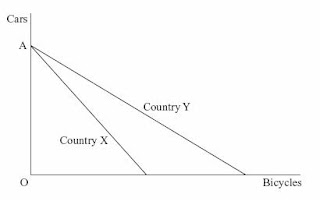
The opportunity cost of cars in terms of bicycles


A is greater for Country X than for Country Y.
B is greater for Country Y than for Country X.
C increases as more cars are produced.
D increases as more bicycles are produced.


5 The National Grid is a system which distributes electricity throughout Britain. It is currently a monopoly. A possible advantage of this monopoly position to electricity customers is that

A a lack of competition in the electricity distribution industry encourages lower prices.
B the monopolist is able to offer lower prices to customers because it can exploit economies of scale.
C by charging high prices, the monopolist is able to ensure an efficient allocation of resources.
D there will be no need for innovation and invention in the electricity distribution industry and so customers can enjoy lower prices.

6 To benefit from specialisation, it is necessary

A to have an efficient means of exchanging goods and services.
B for labour productivity to be high.
C for the production possibility boundary of the economy to be moving outwards over time.
D for significant economies of scale to be gained in all industries.

7 Which one of the following statements involves a value judgement?

A The supply of coffee is likely to be inelastic in the short run.
B Economies of scale can lead to lower prices.
C Inferior goods have a negative income elasticity of demand.
D The government was wrong to introduce university tuition fees.

8 The diagram below shows the demand and supply curves for milk, where P1 is the initial equilibrium price.

The increase in price from P1 to P2 is most likely to be a result of

A an increase in milk production costs and a decrease in the price of complementary goods to milk.
B a successful advertising campaign for a milk substitute and a tax on milk.
C a decrease in the population and an increase in the subsidy on milk.
D a decrease in wages paid to all workers, including farm workers.


9 An external benefit is most likely to arise when

A firms are able to reduce their costs of production by undertaking research and development.
B a reduction in the tax on profits increases the amount of money firms have available for investment.
C the government subsidises commuter rail services in order to reduce road congestion.
D a firm is able to dispose of waste products into rivers free of charge.

10 Government failure occurs when

A government intervention leads to a net welfare loss compared to the free market solution.
B social costs in a market are greater than social benefits.
C the government fails to intervene in the market.
D externalities exist in a market.

11 The table below shows benefits and costs of a new motorway.


From the table it can be concluded that

A the social costs are £80 million.
B the social costs are less than the private costs.
C the social costs are less than the social benefits.
D social benefits are £20 million.

12 Price elasticity of supply for games consoles is likely to be higher

A the higher the income of consumers.
B in the long term than in the short term.
C the slower the rate of change in technological progress.
D the less firms are able to switch resources from the production of other goods into the production of games consoles.

13 All other things being equal, if strawberries and cream are complementary goods, a fall in the price of strawberries will

A shift the demand curve for strawberries to the right.
B cause a movement along the demand curve for cream.
C cause a fall in the price of cream.
D shift the demand curve for cream to the right.


14 The supply and demand diagram below relates to the market for a merit good.

The demand curve for the merit good shifts from D1 to D2, raising the market price from P1 to P2.

To reduce the price back to P1, the government could introduce a

A minimum price of OP1 per unit.
B subsidy of P1P2 per unit.
C subsidy of EF per unit.
D subsidy of GH per unit.


15 In a market economy, the market mechanism can achieve all the following except
A signalling changes in consumer tastes.
B causing supply to respond to changes in demand.
C eliminating excess supply and demand.
D ensuring a fair distribution of all types of good.

Answer:
1. B 2. A 3. D 4. B 5. B 6. A 7. D 8. B
9. C 10. A 11. C 12. B 13. D 14. C 15. D

0

MAS monitoring Inflation

Posted by Economics Corner on 4:55 AM
Monetary Authority of Singapore closely monitoring property prices, inflation to stay tame

Inflation continues to be a key concern for MAS. It noted that business costs like wages and rentals have risen rapidly recently. CPI is expected to pick up in the second half, with the GST hike in July and some price increases in food and transport. The central bank expects CPI for the full year to come in at the upper end of its forecast range of 0.5-1.5%. It foresees inflation creeping up by 1-2% next year.


It's also keeping a close eye on rising property prices. "Impact of the rise in property prices and CPI - the first round effect is small. We'll watch the second round, to see if high prices will pass through to inflation as rental costs get passed on into prices of goods and services. On the financial stability front, the banking sector's exposure to property and construction sectors, as well as housing loans, is significant," said Heng Swee Keat, MD of MAS.

The central bank is maintaining its policy of allowing a modest and gradual appreciation of the Singapore dollar. The Singapore dollar is now hovering at 10-year highs against the greenback.

Source:
Channel News Asia, 25th July 2007 (Extracted)


1a) Identify and explain the cause of inflation mentioned in the news article.
· Cost push inflation
· Cost of production has increased as the article mentioned that such as labour cost (wages) and rentals have increased
· The increase in GST would also cause tax push inflation as it raise the cost of living.
· Producer will increase prices to maintain profit.
· Increase in prices results in inflation.

b) Briefly explain what the Consumer Price Index (CPI) is.
· The CPI shows the general increase in the price level.
· The prices of a basket of goods are measured.
· The prices of the basket of goods in the current year are then compared to that of the base year.

c) (i) Explain what is meant by the ‘appreciation of the Singapore dollar”.

· The increase in the value of the Singapore dollar.
· Against other currencies such as the US Dollar.

(c) (ii) Discuss two impacts on Singapore that will arise from an appreciation of exchange rates.

· When S$ appreciates, prices of exports increase in overseas markets.
· If demand is elastic then foreign currency earnings will fall.
· This will lead to a smaller BOP surplus. Reverse for inelastic demand.
· When S$ appreciates, quantity demanded for S$ increases.
· This cause the BOP surplus to become bigger.
· Only if demand is inelastic will there be no change in foreign exchange expenditure.
· In the long run, the demand for Singapore exports will decrease and demand for the cheaper imported goods will increase. This will then lead to worsening of balance of payments.
· It will increase purchasing power of residents abroad e.g. real estate purchasing.
· Reliance on importer goods which are cheaper. Local industry is adversely affected .


d) Explain the roles of the central bank (MAS) as mentioned in the news article.
· One of its role is shown by the phrase “maintaining a gradual appreciation of the S$”
· it will intervene to prevent excessive fluctuation of S$ exchange rate
· MAS use the exchange rate as the main tool of monetary policy.
· It is “keeping an eye on the rise of property prices” because If the prices of goods and services are distorted by inflation, then there will not be clear signs and guides to efficient allocation of resources.
· Inflation will also discourage saving and investment as the value of assets can be eroded by unexpected inflation.


0

Teaching Resources for Economics

Posted by Economics Corner on 4:10 AM
Useful sites:

INFORMATION
Ministry of Manpower is
http://www.mom.gov.sg/Statistics/
Singapore Statistics http://www.singstat.gov.sg/

Newspapers
1. Straits Times / Business Times -
http://www.asiaone.com.sg/
2. BusinessWeek - Articles for the classroom - http://www.resourcecenter.businessweek.com/
3. CHEER - Computers in Higher Education Economics Review http://www.ilrt.bris.ac.uk/ctiecon/cheer/

Singapore Government Departments
1. Singapore Government Online Portal - http://www.gov.sg/
2. Inland Revenue Authority of Singapore -
http://www.iras.gov.sg/
3. Ministry of Finance - Govt budget, Fiscal policy & Press Releases -http://www.mof.gov.sg/cor/index.html
4. Monetary Authority of Singapore - Economic Research Unit -
http://www.mas.gov.sg/
5. Economic Development Board - http://www.sedb.com.sg/
6. Ministry of Trade and Industry - http://www.mti.gov.sg/

PEDAGOGY & RESOURCES
Economics Educators
http://www.bized.ac.uk/educators/16-19/economics/firms/lesson/buseconomics.htm
· Introduction to Microeconomics

· Markets
·
Firms
·
Wages

· Market Failure
·
Introduction to Macroeconomics
·
AD & AS Model
·
Government Policy
·
Macroeconomic Controversies
·
International Economics
·
Development Economics

Lesson Plans
http://www.eduref.org/cgi-bin/lessons.cgi/Social_Studies/Economics

Conceptual Analysis In Economics (gr. 9-12) The purpose of this activity is to involve students in making decisions and pursuing their own interests within a social and economic environment. Students should develop skills such as critical thinking, decision making, and assertiveness; attitudes, intuition, and the kinds of knowledge and understanding that will enhance continuous change and growth.

Consumer Borrowing and Saving (gr. 11-12) To give students the needed background in the positive and negative aspects of credit, its impact upon individuals and the nation, and practical knowledge and understanding of the wise use of credit.

Division of Labor (gr. 4-12) When studying about the Industrial Revolution and its effects on workers and productivity a short simulation will help students understand why the concept of division of labor was utilized in the fledgling industries.

Entrepreneur (gr. 10-12) This activity is used as a group activity. The students work in groups of four to establish a profitable business that also helps the economy of the community. Give students 2-4 days to do research-- then schedule presentations.

Government and Economics: The Ties That Bind (gr. 11-12) The purpose of this activity is to expand the understanding of students in the areas of both economics and government. It is to also show the relationship between these two subjects and how, over the course of time, our views regarding these two subjects have changed. Its third purpose is to show the relationship of these ideas to current political and economic issues.

Interpreting Economic Indicators (gr. 8-12) Economic indicators are characteristics of an economy that economists use to determine the health of the economy. This activity allows students to explore the many indicators our government follows in order to measure regional and national economic activity.

Microeconomics - Personal Budgeting (gr. 9-12) The purpose of the class is to show students that life in the "real world" away from the secure confines of home is drastically different. Decisions must be made with your spouse or, if you're single, by yourself. The outlook changes when the money comes out of your pocket and not someone else's.

School Store (gr. 4) 1.To understand the need to define categories of store items as a fundamental part of the organization of the store. 2. To use the computer to manage, organize, and access information. 3. To determine which jobs are better handled by computers and which by humans.

Teaching Basic Banking Principles (gr. 11-12) This is a lesson that is intended to be used as a method of teaching basic banking principles. Rather than a dry textbook lesson, this lesson (which is probably best done orally, but can be utilized as a take- home or in-class reading assignment) provides an interesting approach to showing how banks "create" money, what reserves are, and what a "run" on a bank is. The lesson is adaptable to whatever the needs are in your particular situation.

Ups and Downs of the Stock Market (gr. 9 -10) To introduce students to the ups and downs of the stock market
Economics: unlimited wants, goods, services


http://ecedweb.unomaha.edu/lessons/mouse.htm

Games Economists Play
http://www.marietta.edu/~delemeeg/games/games61-70.htm
Game: #61
Course: Micro
Level: Principles and up
Subject(s): Public goods provision.
Objective: Illustrate why the government provides public goods and subsidizes other goods that generate positive externalities
Reference and contact:
O'Sullivan, Arthur and Steven N. Sheffrin. Economics. Upper Saddle River, New Jersey: Prentice Hall, 1997 (p. 289); arthur.osullivan@orst.edu; smsheffrin@ucdavis.edu
Abstract:
Large classes are divided into small groups of students who have the opportunity to support public education through their voluntary contributions. Each group begins play with a $30 balance. Student groups must decide how much to contribute to the public good. Contributions may not exceed $10 per period. Each dollar contributed to the public good reduces the government's expenditures on welfare and criminal justice by $3, so the government enjoys budget savings equal to three times the sum of contributions. The government promises to refund the savings equally among all citizens. The experiment is run for five periods.
Class size: Any size.
Time: 30 minutes.
Variations: None indicated


See also:
Public goods games

Glossary of Economic Terms
http://www.bized.ac.uk/virtual/economy/library/glossary/
http://www.tutor2u.net/default.asp

Other Useful Links: General Economics Education Sites
Business Education on the Internet -
http://www.bized.ac.uk/
EconEdLink -
http://www.econedlink.org/
Economics LTSN - Catalogue of on-line teaching materials for Macroeconomics, Microeconomics, Introductory Economics and Statistics.
http://econltsn.ilrt.bris.ac.uk/teaching/welcome.htm

Federal Reserve Bank of San Francisco - Economics Education Links - http://www.frbsf.org/education/curriculum/index.html

National Council on Economic Education - http://www.economicsamerica.org/

SCORE – Principles of Economics - http://score.rims.k12.ca.us/
http://score.rims.k12.ca.us/resources/grades/?u=196

Tutor 2U Economics - Geoff Riley, Royal Grammar School, Newcastle-upon-Tyne - http://www.tutor2u.net/default.asp

The Singapore Economy
1. Singapore Government – Finance & Economy - Information & Policies -
http://www.gov.sg/pol_fin.htm
2. Report of the Economic Review Committee, 2003 – “Singapore Economy : New Directions” - http://unpan1.un.org/intradoc/groups/public/documents/apcity/unpan004878.pdf
3. Remaking Singapore – Speech by DPM Lee Hsien Loong to Singapore Economics Society, 8 April 2003
4.
Economic Issues - MAS Publications and Papers
5.
MAS Economics Explorer Series
6. MAS Monetary Policy Statement, 2 Jan 2003
7.
National Wages Council (NWC) Wage Guidelines For July 2003 To June 2004

Projects, WebQuests & Simulations
WebQuest – Search page -
http://webquest.sdsu.edu/wqSearch.html
ThinkQuest Internet Challenge Library

-
http://library.thinkquest.org/
Fixitup Faucet Company's Overseas Move - Students play the role of the Secretary of Commerce of different countries and undertake an investigation into the country's demographic & economic characteristics. Objective: to get a company - Fixitup Faucet Company - to establish its plant in the country. Product: a business brochure. The activity concludes with a role-play in which the Board of Directors of Fix-it-up Faucets discuss the merits of each country's proposal and vote on the best option.
http://score.rims.k12.ca.us/activity/faucet/


G8 Online Seminar - Internet-based forum designed to have student participants examine and debate the same economic and geo-political issues as the Summit leaders. http://www.g8online.org/

Virtual Economy – Simulation of macroeconomic management, based around No.11 Downing St. - the British Chancellor's office. http://www.bized.ac.uk/virtual/economy/

Webquest examples http://www.chass.utoronto.ca/~reak/quiz1.htm

NIE trainees' webquests at http://www.hsse.nie.edu.sg/webquest/Econ/erp_webquest.htm

Other Links of Economic Interest
1. The APEC Economies - http://www.gov.sg/apec/
2. Institute for Fiscal Studies – For economic analysis of public policy -http://www.ifs.org.uk/
3. Christian Aid – Reports on aid, debt, development & trade - http://www.christian-aid.org.uk/
4. One World - http://www.oneworld.net/article/frontpage/10/3
5. World Bank Development Education Programme - http://www.worldbank.org/

*contributed by HSSE/ NIE

Links I find useful or interesting - Added by Mrs Lily Lee:
BBC Business news -
http://news.bbc.co.uk/1/hi/business/
The Economists - http://www.economist.com/index.html
Videos on why study Economics:
http://www.whystudyeconomics.ac.uk/films/
Activities and games on why study Economics:
http://www.whystudyeconomics.ac.uk/lecturers/games/
Notes on Economics: http://www.tutor2u.net/revision_notes_economics_gcse.asp
AmosWEB Encyclonomic webpedia
Lessons from econedlink
College Economics
Economic help
S-Cool
revision guru
Study Zone
notes on GCSE Econs

0

Try out the following quiz!

Posted by Economics Corner on 8:46 AM
New – Half-a-minute on Basic Economics Terms
New – match-up game on Economies of Scale
Play this quiz!
Quiz on international organisations
Match the answers - economic indicators

0

National Word Power Challenge Finals 2007

Posted by Economics Corner on 9:19 PM


Congratulations to Ann, Leonard and Chelsy - our team came in 2nd for the National Word Power Challenge Final at the Mediacorps Studio! Click here for the photos.

0

Money, spending, saving and investment

Posted by Economics Corner on 9:02 AM
Learn about money in money land:
http://www.orangekids.com/cedric/money_intro.htm

Learn about spending pattern in spendopolis:
http://www.orangekids.com/cedric/spend_sp_001.htm

Learn about saving:
http://www.orangekids.com/cedric/save_intro.htm

Learn about investment in investment republic:
http://www.orangekids.com/cedric/invest_intro.htm

0

CAN YOU BE THE NEXT MARKET GURU?

Posted by Economics Corner on 9:00 AM
In the following activity, you'll start with $100 in Part 1 and $1000 in Part 2 and attempt to accumulate as much wealth as you can by either investing your money in the stock market or setting it aside safely in the bank. When investing in the stock market, your money will be spread among all the stocks in the market rather than placed in any single stock. This is much like investing in a diversified mutual fund. For those who aren't sure what a diversified mutual fund is, it is simply a fund that pools money from many different investors and invests in a basket of stocks. A single individual often does not have enough money to do this on his or her own. Now click below and begin your quest for guru status.

Part 1
Part 2

Professional investment managers have a variety of statistics they examine in an effort to estimate the relative value of the stock market. To help you with your decision-making process, the main ones they use will be given during your trek through time. Read the following summaries of three key statistics to give you an idea of what information they contain. Keep in mind however, if markets are truly efficient, these ratios may be of little help. Perhaps you will find the relationship that others have not.

1. Price/Earnings (P/E) ratio: This ratio describes how much one is paying for every dollar a company earns. For example, if a company's stock price is $15 per share, and it earned $1 per share over the preceding year, its P/E ratio would be 15. To give you some historical perspective, the average P/E ratio over the last 80 years has been 15.7. As of 4/15/2002 the average P/E for the largest 500 stocks was 25. All else equal, the lower the P/E ratio, the less expensive stock prices are.
2. Dividend Yield: Many stocks pay dividends. Dividends are payments to shareholders from the company's earnings. The dividend yield is the dividend divided by the share price. As an example, suppose you buy stock at $10 a share and the company pays $1 per share in dividends. In this case, the dividend yield would be $1/$10 = 10 percent. For historical perspective, consider that the average dividend yield over the last 80 years has been 4.39 percent. At the end of the year 2001, it was 1.5 percent . All else equal, the higher the dividend yield, the more attractive stocks are.
3. Interest Rate: The one-year interest rate tells you how much you can expect to earn on bonds over the next year. Bonds are fixed-income instruments that guarantee a fixed return. Think of them as savings bonds that you may have. The higher the interest rate, the more bonds pay and the less attractive stocks will be. Thus, as interest rates rise, stock prices generally fall as investors move money out of stocks and into bonds. Conversely, as interest rates decline, investors move wealth from bonds and into stocks.

For the P/E ratio and dividend yield, the preceding five-year average will be given. This will give you a historical context in which to judge these two statistics so that you can at least make an educated guess as to whether the statistics are relatively high or low.
The question you have to answer is whether the statistical value will revert back to its average or keep on trending in one particular direction. For example, if the P/E ratio is above its five-year average, common wisdom would suggest stock prices are relatively high. This may portend that stock prices will soon fall. On the other hand, if P/E ratios have moved above their average, this may suggest P/E ratios are trending upwards and thus stock prices will rise. If all this sounds somewhat contradictory and confusing, it is. Forecasting stock prices is often considered more of an art than a science.


Extracted from http://www.econedlink.org

0
Posted by Economics Corner on 6:39 AM
Singapore and Brunei launch new $20 notes
extracted from Channel News Asia 27 June 2007
A new $20 polymer note has been launched to celebrate the 40th anniversary of the Currency Interchangeability Agreement between Singapore and Brunei. The commemorative notes were launched by Singapore Prime Minister Lee Hsien Loong and the Brunei Sultan Hassanal Bolkiah at a ceremony in Bandar Seri Begawan on Wednesday. Three million of the Singapore $20 commemorative notes will be introduced into circulation gradually through the banks, starting 16 July.
I hope that this article will interest you. You can find out more from the Singapore Mint website at http://www.singaporemint.com/. Please revise on the following this week as we look into the topic on money:
What is money? What are the functions of money? Why is it used as a medium of exchange? What are the forms (types) of money? Why is money introduced as a medium of exchange over barter trade( cons of barter trade)? What are the differences between the Central Bank and the commercial banks?
Write on the following topics:
1. Are Credit Cards A Form Of Money?
you can refer to this link for a comment on the above topic: http://economics.about.com/cs/money/a/credit_cards.htm
2. What are the differences in the functions of the Central Bank and the commercial Banks in Singapore?
you can refer to this link to learn more about the functions of the Central Bank in Singapore: http://www.mas.gov.sg/resource/eco_research/eco_education/explorer/explorer1.pdf
about commercial banks in Singapore:

0

Inflation

Posted by Economics Corner on 9:24 PM

Saw this poster at the MRT station - can you recall what is inflation and the consequences?


1

Essay writing competition winning entries

Posted by Economics Corner on 9:52 AM
Remember about the essay competition for budget 2007? Click on the link below to read the winning entries:
http://www.mof.gov.sg/budget_2007/essay_winners.html#cat1a

0

Study Zone

Posted by Economics Corner on 4:48 AM
Saw this on the internet and found it quite interesting. Questions and answers on economics.
Click on the link below:
http://www.studyzones.com/ActivityZone/answers.cfm?subject=Economics

Copyright © 2009 Economics corner All rights reserved. Theme by Laptop Geek. | Bloggerized by FalconHive.